
A cleaning you do not have to brace for.
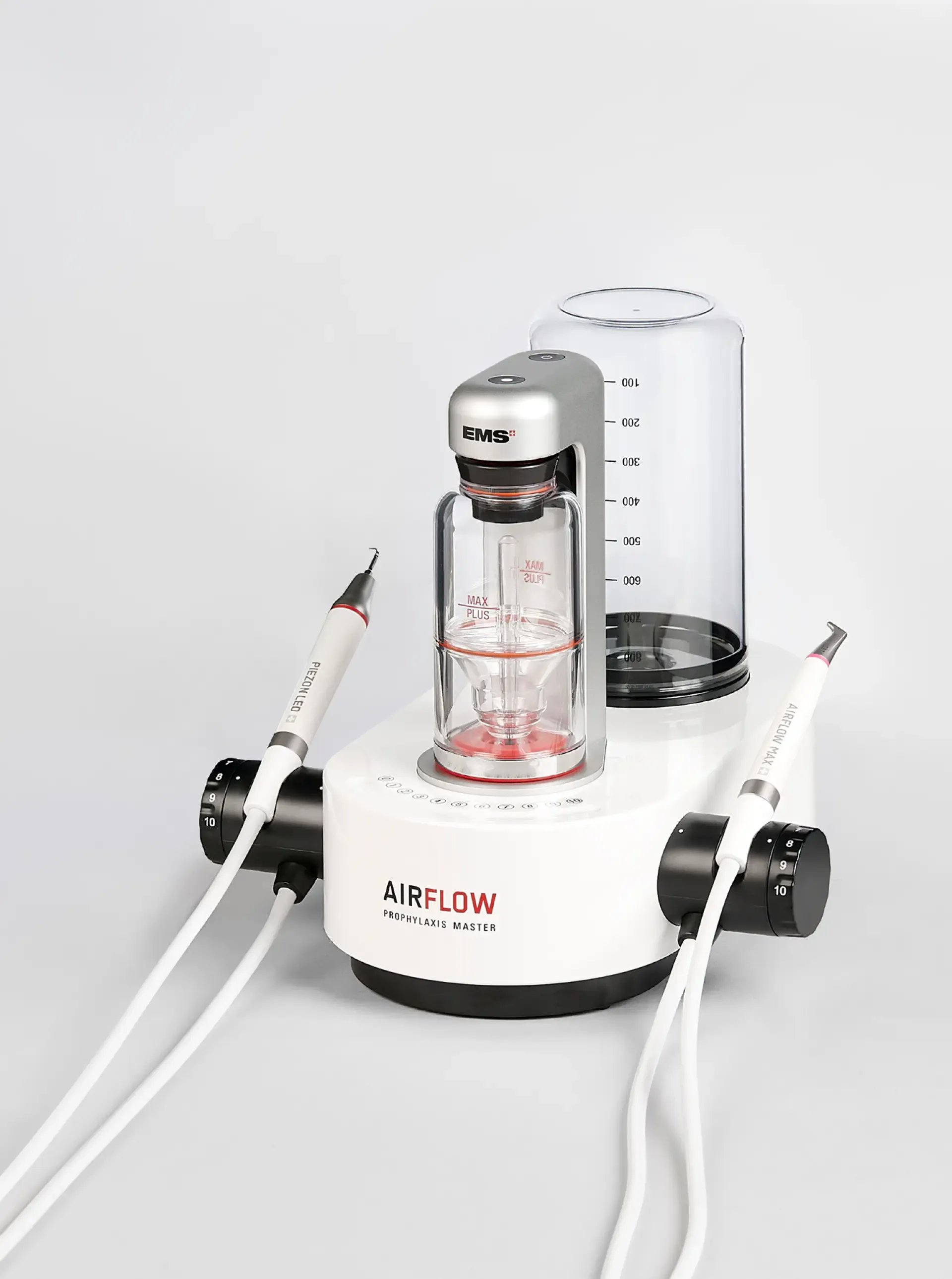
We clean teeth with warm water, a fine powder spray and far less scraping. It is called the AIRFLOW Prophylaxis Master, and the point of it is entirely about how the appointment feels.
The equipment
What it actually is.
The AIRFLOW® Prophylaxis Master, made by EMS, is a single unit that replaces most of what a cleaning used to involve. Instead of starting with instruments, it starts with a warm, low-pressure spray of air, water and a very fine powder that lifts plaque and stain off the tooth without touching it.
Three tools work from the one unit: the spray itself for everything above and just below the gumline, a thin flexible nozzle for deeper gum pockets, and an ultrasonic tip for the hardened tartar that a spray genuinely cannot shift. They are used in that order, which is the part that matters — by the time anything mechanical touches your teeth, there is much less for it to do.
EMS publishes the sequence as Guided Biofilm Therapy. Stripped of the name, it is a cleaning that finds the plaque before removing it, removes the soft deposits with a spray rather than a scraper, and checks its own work in front of you.
What it means for you
Six differences you would actually notice.
Every one of these follows from how the machine works, rather than from how it is advertised.
Warm water, not cold.
The unit heats its water to around body temperature. Cold irrigation is one of the most common reasons a cleaning makes someone flinch, and this removes that particular jolt entirely.
A spray instead of scraping.
Soft plaque, stain and early deposits come away in a fine jet of air, water and powder. No metal touches the tooth for that part of the visit, so there is much less of the scratching sensation and sound people brace against.
Gentler below the gumline.
A thin flexible nozzle can reach into gum pockets several millimeters deep and flush them out, rather than working the area with a hand instrument. For anyone with tender or receding gums, that is a meaningful difference.
Kinder to what is already in your mouth.
The powder used is fine and low-abrasive, so it is suitable around implants, crowns, veneers, bonding and orthodontic brackets — surfaces where traditional polishing paste has to be chosen carefully or avoided.
Less time in the chair.
Because the spray clears the soft deposits first, hand and ultrasonic instruments are only needed on what is genuinely left: hardened tartar. That tends to shorten the part of the appointment most people find tiring.
You get to see it.
Plaque is stained with a harmless dye before we start, so it is visible to you as well as to us, then stained again at the end. You leave knowing what was there and what is gone, not taking it on trust.
The appointment
What happens, in order.
Eight steps, and you are awake and involved for all of them.
Step 1: We look, and we ask
Teeth, gums and any existing dental work are examined and your medical history is checked, including anything that would make this approach unsuitable for you.
Step 2: Plaque gets colored in
A harmless dye makes the biofilm on your teeth visible. Most people have never actually seen it, and it is usually in places they would not guess.
Step 3: We show you what we found
You see the same picture we do, and we talk about the two or three spots your brushing is genuinely missing. This is the part that changes anything at home.
Step 4: The spray does the soft work
Warm air, water and fine powder lift the colored plaque and stain off every surface, above and just below the gumline, without instruments touching the tooth.
Step 5: Deeper pockets, if you have them
Where gum pockets are deeper, a flexible nozzle flushes them out from the inside. Only used where it is needed.
Step 6: Hardened tartar comes last
Whatever the spray cannot lift is hard calculus, and that still needs an ultrasonic instrument. There is far less of it to do by this point, which is the whole idea.
Step 7: We check with the dye again
A second round of staining shows whether anything was missed, while you are still in the chair rather than after you have gone home.
Step 8: We agree when to do it again
How often you should come back depends on what we found today, not on a standard six months for everybody.
Worth knowing
Who tends to feel the difference most.
- Anyone who dreads cleanings. If it is the scraping and the cold water you dislike rather than the dentist, this addresses both directly.
- Sensitive teeth and receding gums. Warm water and no metal contact for the soft-deposit stage removes two of the usual triggers.
- People with implants. Implant surfaces need cleaning that will not scratch them, and this is one of the reasons the equipment exists. See dental implants.
- Braces and aligner patients. Brackets and attachments collect plaque in places a brush struggles to reach, and a spray gets around them. See clear aligners.
- Anyone being treated for gum disease. Pockets can be flushed rather than worked at, alongside proper gum disease treatment — this changes the comfort, not the diagnosis.
It is still a dental cleaning, and it is part of a normal exam and cleaning appointment rather than something separate you book.
Questions
Before you come in.
Most people find it considerably more comfortable than a cleaning done entirely with instruments, mainly because the water is warm and nothing is scraping. It is not anesthetic-free by definition, though: if your gums are inflamed or your roots are sensitive you may still feel some of it, and hardened tartar still has to be removed the usual way. Tell us what you are feeling as we go and we will adjust.
That is one of the reasons for using it. The powder is fine and low-abrasive, so it is appropriate on implant surfaces, porcelain, composite and orthodontic brackets. Traditional polishing pastes are more abrasive and have to be selected with more care around restorative work.
It removes surface stain, which often makes teeth look brighter than they did when you sat down. That is cleaning, not whitening: it takes away what is sitting on the enamel and does not change the color of the tooth underneath. If you want a genuine shade change, that is teeth whitening and a separate conversation.
No. It changes how a routine cleaning feels and it reaches into pockets more gently, but active periodontal disease is still treated as periodontal disease, with measurement, staged treatment and review. Ask us where you actually stand rather than assuming either way.
There are situations where air-polishing is avoided or modified, which is why the visit starts with your medical history rather than with the handpiece. Tell us about respiratory conditions, recent oral surgery, and any advice a specialist has given you, and we will tell you honestly whether this is the right approach for you.
No. Call 281-350-8852 and book a cleaning, and this is how we do it.
Written for patients of Oak Hills Dentistry in Spring, Texas. General dental education, not a diagnosis or a treatment plan for any individual. Equipment described from the manufacturer's published information; how any particular appointment feels is not something a web page can promise. This page is queued for clinical sign-off by Dr. Neal H. Patel before launch.
Start your smile journey.
Tell us how to reach you and we will call to talk it through, no commitment, no pressure.